
Chicopee City Directory Holdings
The Chicopee History Room holds the core local shelf. Its explicit directory list starts with 1875-76 and continues through selected volumes ending in 1989. Earlier scans, later print volumes, voter street listings, maps, and yearbooks are separate tools, not interchangeable records. The online archives catalog describes its City Directories collection as spanning 1863 to 1933, while the History Room identifies 1875-76 as the first specifically listed Chicopee directory run. Treat the catalog range as a collection description and confirm the title and year of any volume before citing it.
| Collection | Years | Where | Access |
|---|---|---|---|
| Chicopee City Directories | 1875-1901; selected later years through 1989 | Chicopee History Room | Print volumes and staff assistance |
| Digitized directory collection | 1875-76 through 1933, with year gaps | Chicopee Archives Online | Free online browse and page scans |
| Street listings from voter lists | 1939-present | Chicopee History Room | Address and street research in person |
| Maps and Sanborn material | Maps 1855-1916; Sanborn 1915 | History Room and Library of Congress | Street and building context |
| School yearbooks | Chicopee High 1942-2017; Comprehensive 1964-2018 | Chicopee History Room | Use with stated gaps |
The printed sequence is discontinuous. The History Room lists 1906, 1911-12, 1916, 1919-33, 1935-38, 1940, 1942-43, 1945, 1947-48, 1950-58, 1960-71, 1974-78, 1980, 1984, and 1986-89 after the early run. A blank year should be recorded as a gap rather than treated as evidence of a move or death.
Chicopee City Directory Scans
Chicopee Archives Online currently presents 45 directory items with browse and sort controls. The digital titles reach from 1875-76 through the 1933 material, which gives researchers a practical first pass before handling a volume. The scan is the source for the printed spelling, abbreviations, street form, and page context. A search result alone is not enough when two local people share a surname or when a village label changes the apparent location.
Digitization also protects the worn directory shelf. The archive collection is useful for name-first work, while the physical History Room remains important for later printed volumes and companion material. If an online year is missing, check the shelf list, then ask the library whether a nearby volume, State Library holding, or another historical source supplies the needed interval. Note: A scan’s availability does not mean every year in the published sequence survives online.
Chicopee History Room Sources
The History Room makes a directory search stronger by keeping the surrounding evidence together: street listings from voter lists, municipal reports from 1848 to 1977, maps, a 1915 Sanborn map, yearbooks, local newspapers, photographs, and historical-home files. Its maps cover Chicopee from 1855 to 1916, helping place an old street description before trying to force it into a present-day parcel number. Walk-in local-history use follows normal library hours, but specialized help may require an advance call or email.
See the History Room collection overview before a visit.
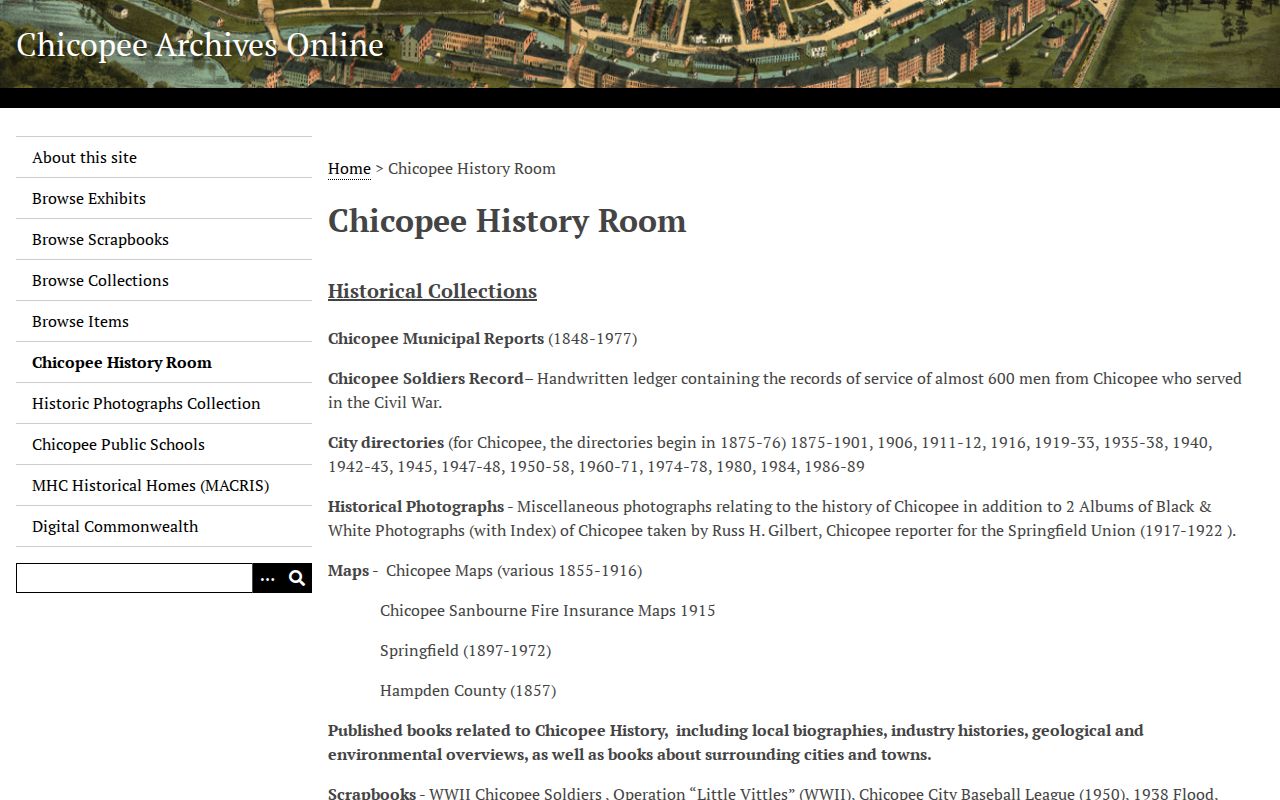
The shelves and supporting collections make it possible to test a directory entry against a map, school record, newspaper notice, or municipal report without treating any one listing as conclusive.
Photocopies cost 10 cents per black-and-white page and 50 cents per color page. Patrons may take photographs, while fragile material may not be copied. Genealogy Open Lab volunteers assist Tuesdays and Thursdays from 10 a.m. to noon and again from 6 to 8 p.m.
Newspaper holdings add useful intervals between volumes. The History Room lists the Olive Leaf, Weekly Journal, Fisk Bulletin, Westover Flier, and Chickuppy, while library resources also point to Springfield Republican research. A notice may confirm a marriage, death, organization, business change, or local event, but it should be compared with the directory year and an original government record when one is needed.
The room is also a practical access channel when an online name search stalls. FamilySearch access is broader inside the library because it is an Affiliate Library, and several other genealogy databases are available only in the building or under provider terms. Historical-home vertical files, family collections, and municipal reports can provide a street or family lead that an alphabetic directory entry leaves out.
How a Chicopee City Directory Reads
A 1928 archive item identifies itself as a directory of Chicopee people and businesses. Its useful parts include alphabetic names, addresses, occupation or employer wording where supplied, household notation, a business directory, and a street index. Copy the entry exactly first. Initials, a widow notation, an apartment mark, or a boarding-house reference can be the small detail that separates one person from another. The volume’s abbreviation key controls how those marks should be read.
| Name | Printed name or initials, kept in the directory’s own spelling. |
|---|---|
| Address | Street address, village wording, or a street-listing reference where provided. |
| Occupation | Occupation, business, employer wording, or other work-related description when printed. |
| Household notation | Relationship, widow abbreviation, apartment, boarding, or co-resident clue when the volume gives one. |
| Street section | Address-first material that can lead back to the alphabetic name entry. |
- Street listing
- An address-ordered list. Chicopee’s separate voter-list street listings begin in 1939 and should be dated as historical evidence.
- Householder index
- A name arrangement focused on the person recorded for a household, not a complete list of every occupant.
- Abbreviation key
- The volume’s explanation of its shorthand. Read it before expanding a printed mark in family notes.
Chicopee City Directory Village Names
Older Chicopee records often preserve the city’s village geography. Cabotville, now generally associated with Chicopee Center, Chicopee Falls, Willimansett, Aldenville, and Fairview can appear as meaningful location words rather than decorative labels. Chicopee stood apart from Springfield only after 1848, so an earlier family trail may use North Springfield or another related place name. Preserve the wording found in the book and add a modern interpretation separately if it is needed for a map search.
The 1875-76 “Streets, Etc.” pages describe streets by junctions and endpoints. That is useful historical geography, but it is not a ZIP code, parcel identifier, or guarantee that street numbering stayed the same. The 1915 Chicopee and Chicopee Falls Sanborn sequence supplies a second view of street labels, building footprints, and uses. Note: Village wording often carries more identifying value than a surname alone.
Soldiers Record With Chicopee Directories
One distinctive companion source is Chicopee’s handwritten Civil War Soldiers Record. The archive describes nearly 600 local service narratives, while another collection description notes more than 500 narratives and ongoing volunteer transcription. These accounts can supply a hometown, family context, or a local association before the main directory years. They are not a replacement for a household listing, yet they can help distinguish two people with similar names when a later directory gives an address or occupation.
Chicopee Archives Online collections also include local journals and newspapers. Use a soldier’s name, the exact directory spelling, a village label, and a newspaper notice together. That combination is especially useful for an estate or death trail, where an obituary and a public probate docket may identify the next documented step. Modern identity confirmation belongs in the Chicopee resident lookup workflow, not in an old listing alone.
Tracing a Chicopee City Directory Household
Follow a household in both directions instead of copying a single entry into a family tree. Each volume is a snapshot, and the gaps in Chicopee’s shelf can create a false story if they are ignored. Street, occupation, spouse or relative wording, and village label are the best local checks when the name is common. Pair them with a census year only after confirming that the public census date is available under the federal 72-year release rule.
- Find the person in a digitized directory or locate the known street in the address material.
- Record the exact spelling, year, page, village, occupation, and household notation.
- Check the nearest earlier and later available Chicopee city directory, writing down any missing years.
- Use the street material to test whether the same address and nearby household continue.
- Compare a public census year, yearbook, map, or newspaper item for an independent match.
- For a documented death, use an obituary and public estate record as separate trail endpoints.
Disappearance from a directory can mean a move, a death, a changed spelling, a changed household role, or simply a missing volume. Search the next available year and companion sources before reaching a conclusion.
Chicopee City Directory Gaps
Later print runs and digital scans leave real breaks. The library’s yearbooks add school affiliation for Chicopee High from 1942 to 2017 and Chicopee Comprehensive from 1964 to 2018, with gaps noted. The History Room’s voter-list street material extends from 1939 forward, while newspapers can provide marriage notices, obituaries, organization news, and address clues. Library database access varies: FamilySearch is broader in the building as an Affiliate Library, and some other genealogy tools are library-only.
When the directory trail reaches the city’s 1848 boundary, check Springfield, county, or church records as well as Chicopee holdings. For an old vital record that says only “City of Chicopee,” use the street index, maps, and a nearby directory year to restore context. These methods keep a missing volume visible instead of filling it with an unsupported assumption.
Municipal reports from 1848 through 1977 are another local bridge when a directory gap overlaps civic life. They can identify city officers, departments, budgets, or public works connected to a year and place. Historical-home files and the 1915 Sanborn material can then test whether the printed street belonged to the same block. For a house-history question, a permit, deed, or newspaper item may further date a change, but each source needs its own date and purpose for future checking. Keep those details beside the fact they support, especially when a village name or address changes across decades.